This is where I share interesting cases and my analysis of the offenders based on my profiling knowledge and information I’ve gained from reading the work of experienced profilers, watching documentaries, and listening to podcasts. The analyses are mine, but I do partner with AI to quickly recap the cases.
September 14, 2025
3. In(Justice): The West Memphis 3 (not the Bike Path Killer… again)
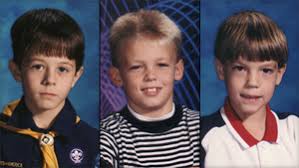

Lately, I’ve been hearing a lot about the West Memphis 3 and it caught my attention. I listened to the episodes on the case covered in The Consult (a podcast hosted by former FBI behavioral profilers) and one episode of The Prosecutors (they have 24 episodes and counting relating to the case which I’m sure I’ll eventually listen to) featuring Julia Cowley- founder of The Consult. I also had the opportunity to watch Paradise Lost, the 3-part documentary about the case on HBO Max and to read the chapters dedicated to the case in original mindhunter John Douglas’s book, Law & Disorder. I understand that Paradise Lost has a clear agenda and that it is not unbiased, which is why I made a concerted effort to consult sources I find to be the least biased- FBI profilers. These professionals are trained to look at the behavioral clues and evidence left behind at a crime scene with no agenda other than determining the characteristics of the most likely perpetrator and helping law enforcement narrow down their pool of suspects. Considering that this is such a controversial case, I want it to be clear that I used multiple sources to come to my determinations.
Recap:
In 1993, three eight-year-old boys—Stevie Branch, Michael Moore, and Christopher Byers—were found murdered in West Memphis, Arkansas. The brutality of the crime shocked the community and created intense pressure for a swift resolution.
Soon after, three teenagers—Damien Echols, Jason Baldwin, and Jessie Misskelley Jr.—were arrested and accused of the killings. They became known as the West Memphis Three (WM3).
- The Prosecution’s Case: Authorities claimed the murders were part of a satanic ritual, leaning heavily on the “Satanic Panic” fears of the era. Jessie Misskelley, who had an IQ around 70, gave a highly questionable confession after hours of interrogation, which was later recanted but still used against them.
- Trials & Convictions: In 1994, Echols was sentenced to death, Baldwin to life without parole, and Misskelley to life plus 40 years. The evidence was weak and largely circumstantial, with little physical proof tying them to the crime scene.
- Public Outcry: Over the years, doubts about their guilt grew. Documentaries like Paradise Lost (HBO) highlighted inconsistencies in the investigation and galvanized public support, including from celebrities like Eddie Vedder and Johnny Depp.
- DNA Evidence & Release: New forensic testing in the 2000s found no DNA linking the WM3 to the murders. In 2011, after 18 years in prison, the three men were released through an Alford plea—a legal maneuver allowing them to maintain innocence while acknowledging the state had enough evidence to convict.
Today, the WM3 remain free, but the case is still technically unsolved. Many believe the real killer(s) were never caught, and the story stands as a powerful example of wrongful conviction, coerced confessions, and the dangers of public hysteria influencing justice.
Satanism at Work
The crime scene was particularly gruesome. It was hard for me to listen to the descriptions and even harder to see the graphic images of the murdered boys on the HBO documentary. Not only had the boys suffered blunt force trauma to their heads and faces, but they had wounds indicating mutilation. One of the boys’ testicles was missing and his penis had been skinned. The boys were naked and had been hogtied. The mutilation, combined with the nudity and sexual overtones of the hogtying, made local law enforcement conclude that this crime was an example of a satanic ritual. They started looking for locals who might be into satanism or related beliefs. They quickly homed in on Damien Echols, a local teen who wore dark clothes, dyed his hair black, and loved metal music. He had researched and dabbled in many religious practices, including Wicca.
They pulled Jessie Misskelley in for questioning, a local teenager with loose ties to Damien. After over 12 hours of questioning without a parent or lawyer present, the teen finally confessed that Damien and his best friend Jason had killed the boys. Jessie admitted that he had contributed by chasing one boy who tried to escape and bringing him back. The police used this confession to arrest Damien and Jason Baldwin.
Most people think of confessions as pretty clear evidence of guilt, however there are numerous factors that can impact the veracity of a confession, and false confessions are not all that uncommon. Here are some major issues with Jessie Misskelley’s confession:
- His IQ is around 72 which puts him into a borderline intellectual functioning range. That means although he is not considered intellectually impaired (typically 70 or below) he is still much more likely than a person in the average range to be highly suggestible, to be vulnerable to coercive questioning techniques, and to struggle with understanding future consequences. After 12 hours of interrogation, he likely admitted to the crime simply to stop the questioning so he could go home.
- Jessie’s details were wrong and the police had to help him get to the correct answers so that they aligned with the facts of the case. For example, Jessie originally said that they found the boys in the woods in the morning, but the crime took place after the boys were out of school, so the officers guided Jessie into remembering that it was actually later in the day. Of the 12 hours of interrogation, only 45 minutes were recorded.
- This confession was used as the cornerstone of the prosecution’s case despite the errors and inconsistencies in Jessie’s confession as well as the circumstances under which the interrogation was conducted.
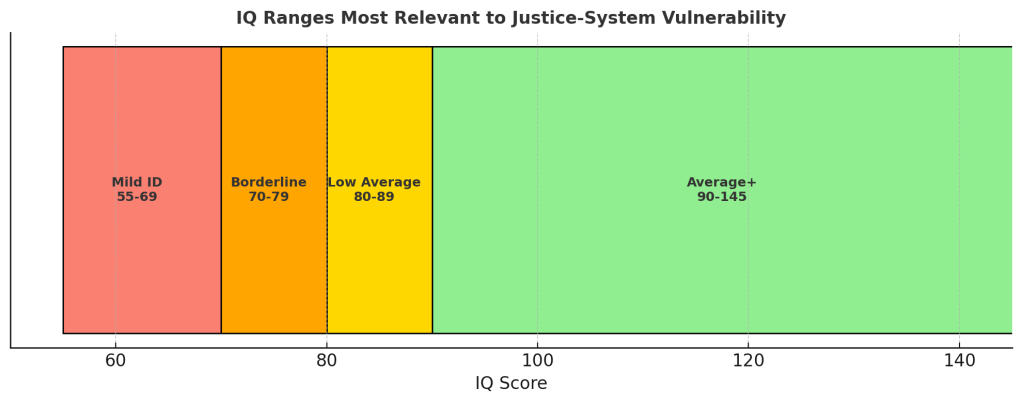
Just for reference, here is information about how IQ impacts a person’s vulnerability to coercive interrogation techniques:
Mild ID (55–69): Highest risk, often cannot grasp legal rights.
Borderline (70–79): Very vulnerable to coercion.
Low Average (80–89): Some risk under pressure.
Average+ (90+): Generally able to understand rights and resist coercion.
Jessie’s confession was used to convict him of murder and he was sent to prison. The prosecutors offered him a reduced sentence if he would testify against the other two defendants in court, but he refused. This resulted in the prosecution not being able to use his confession against Damien and Jason in their trial, but a witness brought it up on the stand, and although the judge directed the jury to disregard what they had heard, it is likely that it played a role in their conviction.
Much of the prosecution’s case hinged on the fact that this was a satanic ritual that Damien had led and that his followers had participated in. He admitted being into Wicca and explained it on the stand. He did not seem to deny any of the factors that so concerned people who thought he was a satanist who murdered children. The prosecution pointed to his weird beliefs and the ritualistic mutilation of the boys’ bodies as evidence that they had been murdered in the name of satan. They entered a knife into evidence that had been found in a lake behind Jason’s trailer park even though it had absolutely no forensic connection to the crime scene. There was just one problem…
The horrific mutilation wounds were caused by animals after the boys’ deaths, not by human beings torturing them in a satanic ritual. In an attempt to hide evidence, the perpetrator of the crime submerged the boys in the creek, then hid their clothes and bikes in the water as well. Most experts in the field agree that the mutilations (including of one boy’s genitals) were caused by snapping turtles and possibly other aquatic life in the creek. Without the mutilation there didn’t seem to be much evidence of satanic ritual.
Unfortunately, the animal predation was not noted at the time of Damien’s and Jason’s trial and they were convicted of murdering the three boys. Jason was given a life sentence and Damien was sentenced to death.
Behavioral Profiling
Paradise Lost is compelling and convincing, but that doesn’t make it reliable. I wanted to know what the crime said about the person or people who committed it and then determine from there if the WM3 were likely to be the perpetrators or not. I did not complete this profile myself, but listened to what Julia and her colleagues determined on The Consult and I considered John Douglas’s thoughts based on his book.
At first glance, this seems like a sexually motivated crime. The boys were hogtied, naked, and mutilated. However, once it became clear that there was no mutilation and no signs of sexual assault, the picture began to change. The FBI profilers find it highly likely that this was a personal cause homicide. This means that the murders were committed for a reason important to the perpetrator that didn’t have to do with sexual motivation or material gain. A domestic violence murder or somebody murdering their best friend in the heat of an argument falls into this category, but road rage incidents would also fall into the category of personal cause homicide. The perpetrator does not necessarily know the victim(s) well, but there will be a reason that is important to the perpetrator that motivated the crime.
The boys were bludgeoned to death in a seeming fit of rage, indicating that they (or at least one of them) did something that angered the perpetrator. It is unlikely that the crime was planned well in advance because of the disorganized nature of the attack and the fact that the boys were tied with their own shoelaces rather than something the offender had brought to the scene.
Although the murders were disorganized, the cover-up was quite organized. The perpetrator submerged the boys so that anybody looking in that area would not be able to easily see them. In fact, the only reason they did find the boys is that an officer fell into the water and landed on one of the bodies (shudder). Their clothes were also submerged in a clever way- they had been wrapped around the end of a stick which was then driven into the creek bed to keep them underwater. Finally, the boys’ bikes were tossed into the creek as well. The attack may have been frenzied, but the cleanup was executed calmly, with rational thought. Why would the offender put so much time into ensuring the boys wouldn’t be found immediately? There are a couple of possibilities:
- The offender was somebody who knew the boys and would be a logical suspect. They needed to delay the finding of the boys so they had time to come up with an alibi.
- The offender was somebody who was known to be in that area of the woods often and would be a logical suspect.
- The offender was a known violent offender living in the area and would be a logical suspect.
Would a stranger with no ties to the area be likely to spend more time at the crime scene than necessary to engage in the elaborate cover-up that occurred? It’s highly unlikely.
Damien, Jason, and Jessie were locals, but do they fit the rest of the profile based on the crime scene? I don’t think they do, and here’s why:
- This offender has the ability to behave calmly and rationally after committing a brutal crime- not likely for three teenagers
- This offender would have a previous violent history- research shows that people don’t escalate to murdering three children at once from never having been violent at all. Although there have been some rumors of cruelty to animals in Damien’s history, nothing substantial has been corroborated, and we don’t see the type of violent behavior likely to precede the level of violence present at this scene
- In order to maintain control of three 8-year-olds the perpetrator had to have some sort of authority over them. This means it was likely an adult they knew they were expected to listen to.
- The type of concealment of evidence present at the crime scene indicates an offender with criminal sophistication. This person understands what can be used to tie him to the crime and knows how to avoid detection. This is a skill highly unlikely to be found in teenage boys with no prior history of major criminal experience.
- There was no physical evidence ever tying them to the crime scene or the murdered boys. There had been fibers found that matched some of the WM3 clothing, but the fibers turned out to be very common and could have come from a lot of different sources.
John Douglas absolutely does not believe that the WM3 committed these crimes. Julia Cowley finds it likely that it was a single offender and that it was very unlikely to be a teenager, although she concedes that age can be a tricky factor in these situations. I am curious to hear what she and her colleagues determine in their final episode on the case that should be released next week. John Douglas put forth Stevie’s stepfather as a compelling suspect, but Julia does not believe he committed the crime.
There is a lack of physical evidence from the scene which makes it really difficult to pinpoint who actually committed the crime. My goal is not to convince you of who did commit the crime, but to make it clear who didn’t: The West Memphis 3. These boys were convicted on nothing but shoddy circumstantial evidence and a whole lot of satanic panic. The more I research cases, the more I discover that people are accused, and even convicted, based on the hunches of the people investigating rather than on actual facts and evidence, and it scares me. The goal should always be to get to the truth, not to make the truth fit what somebody wants the narrative to be.
July 8, 2025
2. University of Idaho Murders
I know I said our next case would be about the Bike Path Killer, but this one was just too interesting to resist. I promise the Bike Path Killer post is coming soon, but for now let’s talk about the murders of four students at University of Idaho in 2022.
My blog is focused on offenders because it is all about behavioral profiling, however, I want to acknowledge that this is not just a fascinating case study, but an account of four young and promising lives cut short. I am so sad that these four victims lost their lives and that their families have to live with that loss. One of the reasons profiling appeals to me so much is that if we can understand these offenders, then we can work toward preventing them from forming. As a teacher, I have understood for a long time that we have to help kids be emotionally healthy or we all pay the price. These types of cases are the most horrifying example of what can happen if we don’t tend to the mental and emotional health of children and youth.
I found the book, “While Idaho Slept” by J. Reuben Appelman at the bookstore recently, and read it in one day. Then, I noticed there was a documentary on the same topic streaming on Peacock, so I watched that too. We can’t really do a proper profile on the offender because we already know who he is, but I did start outlining a profile before I found out who it was, and I would love to share that with you. We can also talk about if the person convicted of the murders makes behavioral sense as the offender because after all, people are wrongly convicted from time-to-time.
Here is a quick recap of the crime:
On November 13, 2022 around 4:00 a.m., four college students named Kaylee, Maddie, Ethan, and Xana were murdered in their home while their two other roommates remained unharmed. The victims had been viciously stabbed multiple times, and there was so much blood it was leaking out of the house. Kaylee was subjected to more violence than any of the other victims. There was no sign of forced entry and the only evidence left behind was a knife sheath.
At this point, I started outlining a couple of ideas about this offender based on the crime scene. This type of extreme violence (wounding beyond what is necessary to kill the victim) indicates an extreme emotional reaction. This may point toward an offender who knew the victims and was enraged toward them, a person suffering from significant mental health issues such as paranoia or delusions, or an inexperienced offender acting out a violent fantasy they’ve been harboring for some time. Based on this knowledge I had two guesses about the offender:
- They knew Kaylee and Maddie and had targeted them because of a real or perceived slight (I’m guessing they knew these two because the most rage was concentrated on Kaylee, and Maddie was her best friend and they had been out socializing together prior to the murders). The fact that there’s no sign of forced entry initially supports the idea that the intruder knew the victims.
- Or… this is a socially awkward, inexperienced offender with some mental health issues. Based on the fact that the offender entered at night while the victims were likely to be sleeping, this may be a person who is not confident in their ability to commit their crime without the element of surprise. Overkill, if not the result of a personal conflict, is a sign of a person overwhelmed by their emotions and not able to fully control themselves.
I noticed several disorganized traits in this crime scene:
- The murders seemed to be a chaotic frenzy of uncontrolled violence
- The knife sheath was left behind- if this was done intentionally then we could be working with a highly organized offender, but the crime itself doesn’t really support that
- The victims were left where they were killed and there was no attempt to conceal them
- One roommate saw the offender as he walked right by, but he left her alive and simply departed- maybe he was exhausted at that point?
I was actually leaning towards this being some sort of revenge by somebody the occupants of the house knew, but now I know that’s not the case. The offender had no known connections to any of the victims. This is part of the process of being a novice profiler- each thing I get wrong helps me learn more than anything I get right. Happily, my second working profile was pretty close!
My estimation of the killer’s level of organization started to change as new information came in. A car was noted heading toward the home right before the murders and leaving shortly after. It was discovered that this vehicle had been doing loops going back and forth in front of the house for a while, indicating that the driver was staking it out and making a plan. We see this in highly organized offenders who carefully plan prior to committing their crime. It was also later learned that this car had possibly been driving by the house several times in the weeks prior to the attack. This could be a strong indicator that our offender is fantasy-motivated and had been working up the courage to make his fantasy into a reality. Also, the fact that the offender brought his own weapon and took it with him after the commission of the crime is an organized trait. This helped me further understand that rather than being somebody completely out of control (with paranoia or delusions), the chaos we see at the scene, combined with leaving evidence behind (the knife sheath), is indicative of an inexperienced organized offender. I have every confidence that had this person not been caught, he would have refined his skills over time and evolved in his execution of violent crime.
Who’s the Offender?
28-year-old Criminal Justice PhD student at Washington State University, Bryan Kohberger was charged with the murders and eventually pled guilty rather than standing trial. This way he avoided a death sentence, but it was an interesting decision considering much of the evidence was circumstantial. Although his DNA was found on the knife sheath left behind at the crime scene, it was touch DNA which is notoriously less reliable than the type of DNA obtained through bodily fluids. He might have had an opportunity to be found not guilty because of reasonable doubt if he had gone to trial. Based on the behavioral evidence, is it likely he’s guilty or innocent?
Throughout the book and documentary, many people from Kohberger’s past, both distant and recent, commented on his off-putting demeanor and “creepy” behavior. He was known to stare women down and make bizarre comments like, “You have great birthing hips,” after a failed first date. Cringe. He was not known to have ever had a girlfriend or many friends for that matter. He was significantly overweight, but then became fit as a teenager. Unfortunately, his newfound physical confidence did not equate to social prowess. He continued to struggle with other people even after his physical transformation.
He battled with a physical ailment called “visual snow” that disrupted his vision, hearing, and sense of reality. In online forums he lamented having to deal with such a frustrating condition, and he also shared some concerning psychological issues. He stated that he regularly experienced depersonalization, a phenomenon in which you feel like you or your surroundings are not real. He went on to disclose that he did not feel capable of empathizing with others or experiencing remorse for his actions. He noted that he had delusions of grandeur and called himself an asshole. He knew something wasn’t right, but he also knew he couldn’t do anything about it. In the documentary, it was noted that he seemed to have an “incel” mentality- the resentment of someone who is involuntarily celibate as a result of their unappealingness to the opposite sex (for whatever reason).
He had a brief addiction to heroin, but was able to get clean. He went on to obtain his master’s degree and was then accepted to the PhD program he was participating in at the time of the murders. A person really has to have their life together to achieve at such a high academic level, but Kohberger seems to be a man of contradictions. Although highly organized and successful in some aspects of his life, he was markedly unsuccessful in others- namely in interactions with other people. As a PhD student, he also assisted in teaching undergraduates. Multiple female students complained of his condescending attitude toward them and his creepy demeanor. He became emotionally distressed and angry when his cooperating professor discussed the complaints with him, shouting and ranting. He was given a warning and a list of expectations he needed to meet in regards to his behavior if he did not want to lose his teaching assistantship, which he needed in order to pay for his PhD program.
Bryan Kohberger seems to have had a relatively normal childhood. He grew up in a two-parent household, and was the youngest of three children. His parents did have to file for bankruptcy twice, so perhaps there was tension around financial stress, but I haven’t seen any evidence of abuse in the home. However, Kohberger did suffer abuse at school in the form of bullying from other students, including popular girls. Even after his remarkable physical transformation, those girls would still not give him the time of day.
So is Bryan Kohberger the type of person likely to perpetrate the type of horrific murders that occurred in Idaho in November 2022?
Yep. He absolutely is.
- The type of overkill seen in the murders (especially directed at Kaylee) indicates rage and an intense emotional response
- This type of chaotic crime is indicative of someone in a chaotic psychological state- he had mentioned his struggles with depersonalization, lack of empathy, and grandiosity
- He clearly thought little of women based on his condescending interactions with them
- He suffered a lot of rejection as a kid and as an adult, which can lead to feeling justified in murdering the types of people who had rejected him in the past
- Maybe he was acting out displaced rage on Kaylee and the others as a form of revenge?
- This offender was both arrogant and insecure
- Breaking into a home with multiple people, including an athletic male, and murdering several of them requires an arrogant feeling of being able to overpower others and outsmart the victims and police
- Entering the home at night while the victims were asleep makes it much easier to overpower them. He can act out his fantasy with relatively docile victims by blitz attacking them and never giving them a chance to fight back
- Kohberger stated that he had delusions of grandeur and lacked empathy- these are hallmarks of narcissism. Although narcissists appear to have a ridiculous amount of confidence and self-assurance they are actually debilitatingly insecure.
- Kohberger’s mix of organization and emotional volatility are evident in this crime scene
- Just like he had to be an organized, careful planner to pursue advanced degrees, there was careful planning evident in the crime, including the fact that he had driven past the home multiple times, turned his cell phone off during the commission of the crime so it could not be tracked, and brought his own weapon to the scene
- Just like the emotional volatility evident in his shouting at a professor, the crime scene devolved into chaos, even after careful planning. He seemed to lose control and violently lash out indiscriminately rather than in a controlled manner typical of more experienced offenders. He left the knife sheath behind- a huge rookie mistake, and he left some witnesses in the home alive. Perhaps he was just too exhausted to continue on his tirade, or maybe as a form of control he chose who lived and who died
I have a feeling Kohberger had a rich fantasy life full of domination and control over the type of people who had been rejecting him his whole life. Unfortunately, offenders like this often find surrogates to fill in for the people who wronged them (or they perceived have wronged them). I don’t know if Ethan was part of that fantasy or if he just happened to be in the wrong place at the wrong time- it seems like most of the rage was directed at the girls. Considering that this attack had to do with a fantasy of power and control, I think it’s very likely that Kohberger had previously committed undetected violating crimes, such as breaking into people’s homes while they were gone- just to enjoy knowing he could invade the private space of others, or voyeurism (watching people without their knowledge). As we know, killers like this don’t just decide to murder one day- it is a slow buildup of fantasy, planning, and escalating crimes. Based on the incongruence of the offender’s intelligence with the sloppy execution of the crime, I would guess this was his first murder.
Had he not gotten caught would he have continued to offend?
Definitely. This type of offender would have taken what he learned and adjusted his M.O. for the next time. The fantasy would begin to build again and he would have needed to indulge himself again at some point.
Similar Offenders
As I read about these murders, I was reminded of a couple other offenders I’ve read about:
- Dennis Rader (BTK)
- He was a home invader who subdued multiple people at once, including men
- BTK was a careful planner who fantasized about control and total domination over others. He made some mistakes early on, but was lucky enough not to get caught.
- BTK was famously arrogant and liked to lord his perceived superiority over others. He taunted law enforcement in various communications and thought he could outsmart everybody. This arrogance was eventually his downfall. I see similar arrogance and a need to make it clear that he is more intelligent than everybody else in Kohberger. I think he may have eventually started communicating with and taunting law enforcement and/or the public if he had not been caught after his first murder.
- John Joubert
- John Joubert was a young offender who lured boys off of their bicycles so that he could violently murder them with a knife.
- He was organized enough to lure victims without force, but then got lost in a chaotic emotional frenzy as he murdered them. He also left bodies out in the open, rather than trying to hide them, as a more experienced and organized offender would
- Overkill was a hallmark of Joubert’s murders, and profilers noted the amount of rage present in his attacks. Although the attacks were motivated by rage, there was also evidence of fantasy- a desire for power and control.
I’m a novice profiler, and I know that I won’t get everything 100% right, so I want to hear your thoughts! Do you agree with me? Is there anything I haven’t considered or that you have a different opinion about? Please leave your thoughts in the comments.
Resources
Appelman, J.R. (2023). While Idaho slept: The hunt for answers in the murders of four college students. Harper.Park, C. (Director). (2025, July 3). Idaho Student Murders [Film]. Peacock.
1. JonBenet Ramsey
This is the case that started it all for me, and considering the fact that Netflix recently released a documentary about the case, I thought it made sense to start with this one.
Background


JonBenet Ramsey was a six-year-old little girl who enjoyed competing in local beauty pageants. I remember her angelic little face staring back at me from the magazines at the check stand when my mom and I were grocery shopping. The details of the crime were truly horrifying.
On the morning of December 26, 1996, six-year-old JonBenét Ramsey was reported missing from her family’s Boulder, Colorado home. Her mother, Patsy Ramsey, called 911 around 5:52 a.m. to report a kidnapping, stating she had discovered a lengthy ransom note demanding $118,000 for JonBenét’s safe return. The note was found on the staircase leading to the kitchen.
Despite the ransom note’s warning not to involve police, law enforcement arrived at the house shortly afterward. An initial search of the home did not reveal JonBenét’s whereabouts. Several hours later, just after 1:00 p.m., her father, John Ramsey, discovered her lifeless body in a little-used basement room, commonly referred to as the “wine cellar.” JonBenét was found covered with a white blanket, her wrists bound, and duct tape over her mouth. A makeshift garrote made from a broken paintbrush and a cord was found around her neck, and there were signs of both blunt force trauma and strangulation.
The crime scene was severely compromised early on. Friends were invited into the house, police allowed the family to move freely, and John’s discovery of the body further disturbed potential evidence. The ransom note, unusually long and written on paper from inside the home, also raised suspicion.
No one was ever charged with JonBenét’s murder. The case remains unsolved and continues to spark public fascination and debate—particularly regarding the crime scene, the note, and the behaviors of those involved in the hours following her disappearance
Two Opposing Theories
There were two major theories about who killed JonBenet: The parents or an intruder. Let’s explore both theories and determine which one makes the most sense based on behavioral and forensic evidence.
The Parents
Statistically, when a young child is killed, it is highly likely that a family member was responsible. Detectives immediately suspected the parents, and rightly so based on their training. However, good detective work does not rely on statistics alone; they give a good starting place, but the evidence must support the theory. Early on, detectives focused on JonBenet’s father, John. The police officer who spent the most time with the Ramseys on day one, and who was present when JonBenet’s body was discovered by John, said she immediately knew John was the murderer once he found her body, and that she felt she was looking into the eyes of evil when she made eye contact with him. I fully support listening to one’s intuition, but again, the evidence must match the theory. Detectives hypothesized that John had been sexually abusing JonBenet for some time, and this time things accidentally went too far and he killed her. Male DNA had been found in JonBenet’s panties and under her fingernails, and unfortunately for the detectives who were sure John was the perpetrator, that DNA did not match John Ramsey or anyone else in the Ramsey family.
After the John Ramsey theory didn’t pan out, focus moved to Patsy Ramsey, JonBenet’s mother. Detective Steve Thomas theorized that JonBenet had accidentally peed the bed in the middle of the night, sending Patsy into a rage. In this fit of rage, Patsy supposedly struck JonBenet hard enough that she was sent reeling into the edge of the bathtub where she hit her head. Once Patsy realized she had killed her daughter, she panicked and attempted to stage the scene to look like a sexual crime committed by an intruder. Before we determine whether this truly could be what happened, let’s look at the other theory: an intruder was responsible for JonBenet’s death.
An Intruder
Eventually, investigator Lou Smit was brought in to assist Boulder PD with their investigation. He was an experienced and successful homicide detective, revered for his clearance rate. His determination was that an intruder had come into the Ramsey’s home while they were away at a Christmas party, and had hidden in the house until they went to sleep. He discovered some strange marks on JonBenet’s body that he determined to be taser marks. He hypothesized that the intruder incapacitated JonBenet with the taser, then took her down to the basement to assault and murder her. The parents’ bedroom was on the opposite side of the house from JonBenet’s and on a separate floor, so it’s unlikely they would have been able to hear the intruder as he abducted JonBenet from her bed and took her down to the basement, and they definitely couldn’t have heard anything all the way down there. Smit felt that the offender’s point of entrance must have been a broken window under a grate leading to the basement, and that the offender had plenty of time to explore the house, choose his materials, and write the ransom note.
Which Offender Fits the Profile?
One thing I love about behavioral profiling is that it makes people seem a lot more predictable and understandable. In his book, The Cases That Haunt Us, former FBI profiler, John Douglas states that the best predictor of future behavior is prior behavior. If we are to consider Steve Thomas’s theory that a mother accidentally killed her daughter in a fit of rage, then brutally raped her with a broken paintbrush and garroted her so violently that the cord was embedded in her skin, we have to deduce that Patsy Ramsey is some sort of psychopath who was so concerned about her own welfare that rather than being consumed with remorse over killing her only little girl, she was willing to defile her daughter in unthinkable ways and write a nonsensical ransom note simply to avoid being caught. As Douglas points out, people don’t suddenly become capable of depraved violence. Even flying into a rage and accidentally killing her own daughter would have been completely out-of-character for Patsy, let alone staging a brutal murder of that daughter. Here are some examples of psychopaths who could not fully mask themselves from the people closest to them.
- Ted Bundy– Ted was notorious for being able to trick people into thinking he was a nice, regular guy. However, there were incidents in which his other side would show through just a bit. His former longtime girlfriend, Liz, describes some of these incidents in her book, The Phantom Prince. In one situation, her young daughter was swimming and becoming tired, but anytime she tried to get back into the boat, Ted would move it out of her reach. She and her daughter describe a change in his eyes, and how he seemed to be getting pleasure from keeping the poor girl from safety. He also loved jumping out and scaring Liz whenever he could, laughing hysterically at her frightened reactions. Although he was able to mask from most people, he gave little clues about his true nature to those closest to him.
- Jose Menendez (to be fair- not a diagnosed psychopath as far as I know. This is just based on my observations)- Famously murdered by his two sons, Lyle and Erik, Jose Menendez was known by close relatives, friends, and acquaintances alike to be a domineering bully who imposed his will on everybody else. The boys’ aunt also testified about how one of the boys reported his father was sexually abusing him, and how she told their mother about it, but nothing was done. It was widely known that Jose was a pretty horrible human being and many people were not particularly surprised when such accusations came out against him during the trial of his sons.
The point of these two illustrations is to show that if somebody is capable of committing terrible acts, somebody will have had a prior interaction with them that could make such behavior plausible. They never could find anybody who could say something of the sort about John or Patsy Ramsey- they were known to be loving and gentle parents.
Let’s pretend we can suspend our knowledge about the behavioral inconsistencies and go along with Steve Thomas on his theory about Patsy Ramsey. It turns out, the forensic evidence just doesn’t support it either. JonBenet’s death was determined to be caused by strangulation and head trauma- they seemed to happen so close together that it was difficult to determine which was the actual cause of death. There are some clues that give us a pretty good idea though. For one thing, there was hemorrhaging in her eyes and heart, indicating that she was alive while she was being strangled. There are also injuries to her vagina that indicate that she was alive at the time the paintbrush was being used to sexually assault her. Finally, there was very little bleeding from the head injury. Head injuries notoriously bleed a lot, and the only reason this one wouldn’t is that she had already been killed by strangulation prior to the head wound being inflicted. This means that to kill her own daughter, Patsy Ramsey would have had to strangle and sexually assault her, which is something you simply don’t see loving, or even ambivalent, mothers do.
Ransom Note
The ransom note is another particularly interesting and confusing part of this case. The offender wrote the note on a legal pad found in the Ramsey home, and it appears that they even did more than one draft. The original draft was addressed to Mr. and Mrs. Ramsey, but the final draft was addressed to Mr. Ramsey alone. Some of the interesting things to note:
- It was a very long ransom note. In true ransom notes, the individual quickly gets pertinent information across and does not add superfluous details.
- It had a lot of movie references, with lines from movies like Speed and Dirty Harry. This indicates that the writer may have been trying to imitate what they thought a ransom note should include based on movies they had seen.
- The amount of money requested was very strange. It was $118,000- almost the exact amount of a bonus John had recently received from work.
- The note was addressed to John and seemed to be angrily directed at him.
If you want more information about the ransom note and how the following conclusions were made, visit The Consult podcast: JonBenet Ramsey: The Ransom Note, Part 1. This note indicated a couple of things to profilers:
- The note seems to be directed at John, and the person who wrote it is angry with him. The writer could be someone who resents John’s success or someone who has reason to be angry with him regarding his business. Requesting the exact amount of his bonus seems to a small way of equalizing the person’s perceived unfairness of John’s success. It could also indicate someone who would know what the bonus was (through work or somebody close to the family who would know such information) or a person who happened to see paperwork indicating the amount of the bonus as they roamed around the home.
- The movie references can lead us to the conclusion that the offender is pretty young or at least emotionally immature. It also indicates a certain level of fantasy. The offender is staging the scene to look like a ransom, but their only knowledge of such things is through movies.
So, Who Killed JonBenet?
I think at this point it’s pretty clear that I do not believe that the parents killed JonBenet. The behavioral and forensic evidence do not support that conclusion. I find it somewhat infuriating and baffling, that when faced with contradictory evidence to his theory, Steve Thomas clings resolutely to it- even publishing a book about it! I can understand getting lost in a theory temporarily, but it boggles my mind that one would not be willing to change that theory when presented with evidence that supports something completely different.
Some people have claimed that JonBenet’s nine-year-old brother, Burke, killed her. I am going to spend very little time on this because I find it completely asinine. A child is not capable of creating a garrote (especially without access to YouTube) and exerting the amount of force necessary to murder someone with it. He also couldn’t have written that long-winded ransom note. And just like in the case of the parents, there were no prior behavioral indicators to suggest that he would be capable of such a thing.
I agree with Detective Lou Smit and former FBI profiler, John Douglas, that an intruder committed this crime. At first, I thought this appeared to be the work of a sexually sadistic killer. She was bound and her mouth was duct taped. Garrotes are used for power and control, and can be used to torture the victim by causing them to lose consciousness, then waking them to be strangled again. There was also a broken paintbrush shoved into her vagina, which seems pretty sexually sadistic to me. However, profiles are not created in a vacuum, and the ransom note indicates that this could be a personal cause homicide. The perpetrator is angry with John and seeking revenge. It is likely that the offender brought some materials with him (the cord used in the garrote and the duct tape were never found, leading detectives to believe that he brought it with him and took it with him when he left) and that he used some materials at the scene. There is evidence of some organization, but leaving the body behind, and the nature of the ransom note indicate a young, less experienced offender. Although on the surface, the crime appears to be the work of a sexual sadist, we would expect to see similar crimes if that were the case- there were none. Douglas believes the offender was on the younger side (late teens to early twenties) and that he had some connection to the family. Although he and Lou Smit agree that an intruder was responsible, Smit believes the murder was the work of a pedophile. Of course it’s difficult to say, but the personal nature of the ransom note, the ability to find one’s way around the labyrinthine house, and the access to the home makes it likely that this offender knew the family, or at the very least, stalked the family prior to committing the crime.
One thing that frustrates me so much is that if the offender had a connection to the family, it may have been relatively easy to catch him if the investigation had been conducted correctly. The early corruption of the crime scene and the refusal of detectives to consider any perpetrators other than the parents significantly reduced the possibility of ever catching JonBenet’s killer. You never know when a cold case might be solved, and I still hope that someday we get answers. At the very least, I hope it is clear that JonBenet’s family members were not responsible for her death. A horrible thing happened to a family who deserved nothing but happiness, and the fact that they were blamed for their daughter’s death is a whole tragedy in and of itself. I think this case is evidence of what happens when investigators base their theories on their own feelings and what-if scenarios. We have to remember that behavioral and forensic evidence must be evaluated to create a theory rather than determining a theory and trying to make the evidence fit.
Update (July 8, 2025):
I recently discovered that The Consult podcast has two episodes about the whole Jon Benet Ramsey case in addition to the two I listened to regarding the ransom note. I have a couple of updates based on the information I gleaned:
Although the strike to Jon Benet’s head catastrophically fractured her skull, it did not break the skin, which is why there was no blood. Previously I had cited the lack of blood as an indication that she had died by asphyxiation prior to the skull fracture occurring.
The former FBI profilers on the consult determined that the intruder likely was a pedophile, just like Lou Smit theorized. They also determined that there was a personal vendetta against John Ramsey, like John Douglas had asserted. They bring the two theories together, hypothesizing that the intruder had targeted Jon Benet, but that it was an added bonus that he could seek revenge against John. I can definitely get behind this theory. The profilers of The Consult also concurred that the perpetrator knew the Ramsey family in some capacity.
This new information does not change my opinion about the offender being an intruder rather than a family member, but I wanted to acknowledge it since it could impact the opinions of other novice profilers, and I want you to have as accurate information as possible.
I encourage comments and disagreements, as long as they use logic and reasoning and are communicated respectfully.
References
Berlinger, J. (2024). Cold case: Who killed JonBenet Ramsey. Netflix.
Cowley, J. (2023). JonBenet Ramsey: The Ransom Note Parts 1 & 2. The Consult: Real FBI Profilers. https://www.truecrimeconsult.com/jonbenet-ramsey-the-ransom-note-part-1/
Douglas, J. (2000). The cases that haunt us. Scribner.
 Wolves in the wallpaper
Leave a comment